
Did You Know?
Aurel Stein, famed Silk Road archaeologist, served as the museum’s first curator in 1901.
34°00'28.7"N 71°33'30.7"E
Aurel Stein, famed Silk Road archaeologist, served as the museum’s first curator in 1901.
The Best Time to Visit mountain regions of Khyberpakhtunkhwa is Summers. Preferably from April to September. Winters are Extremely Cold and Snowfall blocks most of access. Hence Winters are not recommended.



Peshawar Museum, housed in the former Victoria Memorial Hall on GT Road, is one of the largest museums in Pakistan and is celebrated for holding one of the world’s most extensive collections of Gandhāran art. Constructed in 1906–07 at a cost of Rs 60,000—of which Rs 45,000 were raised by the public of the then North‑West Frontier Province and Rs 15,000 were granted by the Director‑General of Archaeology, India—the building originally commemorated Queen Victoria. The museum formally opened in November 1907 to accommodate sculptural material excavated from major Gandhāran sites such as Shah‑Ji‑Ki‑Dheri (Peshawar), Sahri Bahlol, Takht‑i‑Bāhī, and, subsequently, Jamāl Garhī and other locations investigated by British scholars. Behind the museum stands the Abasin Arts Council, reinforcing the area’s cultural focus. Peshawar Museum first opened to the public in 1901 with archaeologist Aurel Stein as its inaugural curator; after its establishment in 1907 it was administered by the Peshawar Municipality, while the Superintendent of the Archaeological Survey of India, Frontier Circle, acted as honorary curator.
Over time the governance structure evolved. When the Frontier Circle office moved to Lahore in 1927, the provincial government appointed a full‑time curator at Peshawar. After Independence, the museum came under the control of the Director of Public Instructions, Government of Khyber Pakhtunkhwa. In 1971 an autonomous Board of Governors—initially chaired by the Governor and later by the Chief Secretary—was created to oversee operations. The Khyber Pakhtunkhwa Directorate of Archaeology and Museums was formed in 1992 to safeguard the province’s archaeological heritage, and the Peshawar Museum was placed under this directorate.


The principal hall still functions within the original Indo‑Saracenic structure of Victoria Memorial Hall, while new galleries have been added as the collection expanded. Today the museum’s holdings are organised in three major sections: the Mahātmā Buddha (Gandhāra) Gallery, the Islamic Gallery and the Ethnological Gallery. The Mahātmā Buddha Gallery, instituted in 1969–70, displays 336 sculptures—chiefly images of the Buddha and Bodhisattvas in diverse postures together with intricate reliefs illustrating Jātaka stories. Most pieces derive from Takht‑i‑Bāhī, Jamāl Garhī, Sehri Bahlol, Charsadda and Shah‑Ji‑Ki‑Dheri, highlighting the stylistic range of Gandhāran expression.
The Islamic Section, created in 1974–75, now comprises 434 objects, including Qur’anic inscriptions, calligraphy panels, manuscripts, woodcarving, metalwork and paintings. A specialist Qur’an gallery, inaugurated on 8 February 2003, houses Iranian calligraphic pieces donated by the Iranian Consulate. Notable inscriptions include a Kufic example from Hund dated 482 A.H./1090 A.D., a Mongolian‑style panel from Sher Talo in the Tōchī Valley, and two bilingual Mongolian–Śāradā stones from Khazana donated by Captain A. H. Barnes; another Kufic–Śāradā inscription from Tōchī dated 243 A.H./857 A.D. was presented by Mr Pears. Seventeen calligraphic specimens in Naskh, Nastʿalīq, Shikasta and Khat‑i‑Ghubār scripts by masters such as Dārā Bakht, Nizām ʿAlī and ʿAbdullāh Beg are displayed alongside eighteen carved wooden panels, silver and copper vessels, and paintings that range from depictions of Hindu deities—Krishna, Śiva, Hanumān—to Mughal court scenes such as Jahāngīr enthroned. Twenty‑nine handwritten Qur’ans are exhibited, ten in Khat‑i‑Ghubār (the earliest dated 818 A.H.); others were penned by Muhammad Amīn (955 A.H.), Ahmad Kashmīrī (1227 A.H.) and Faqīr Qādir Bakhsh (1041 A.H.). Sixty‑four Arabic, Persian and Pashto manuscripts on poetry, theology and science—among them *Kimyā‑i‑Saʿādat*, *Shajra‑i‑Najībullāh* and *Kitāb al‑Khwarizmī*—complete the section.
Established concurrently with the Islamic Gallery, the Ethnological Gallery holds 348 artefacts documenting the material culture of Khyber Pakhtunkhwa’s diverse communities between the nineteenth and twentieth centuries. Twelve carved wooden Kalasha effigies commemorate the deceased; mannequins portray Turis, Mahsuds, Kohistanis, Chitralis and Kalashas in traditional attire. The exhibition also features tribal weapons—swords, daggers, bows and matchlock guns—along with domestic implements crafted from wood, bronze and leather. Embroidered textiles from Swat, Kohistan and Waziristan and jewellery of silver and gold—earrings, amulets and anklets—illustrate regional craftsmanship.
The museum building itself exemplifies late colonial civic architecture, its brick façades and cupolas providing an imposing yet harmonious backdrop to the collections within. Since its establishment, Peshawar Museum has served scholars, students and visitors alike, offering a comprehensive narrative of Gandhāran Buddhist art, Islamic calligraphy and the ethnographic heritage of north‑western Pakistan. Continual administrative evolution—from municipal oversight to provincial stewardship—reflects the institution’s expanding mandate to preserve, interpret and showcase the province’s rich archaeological and cultural legacy.

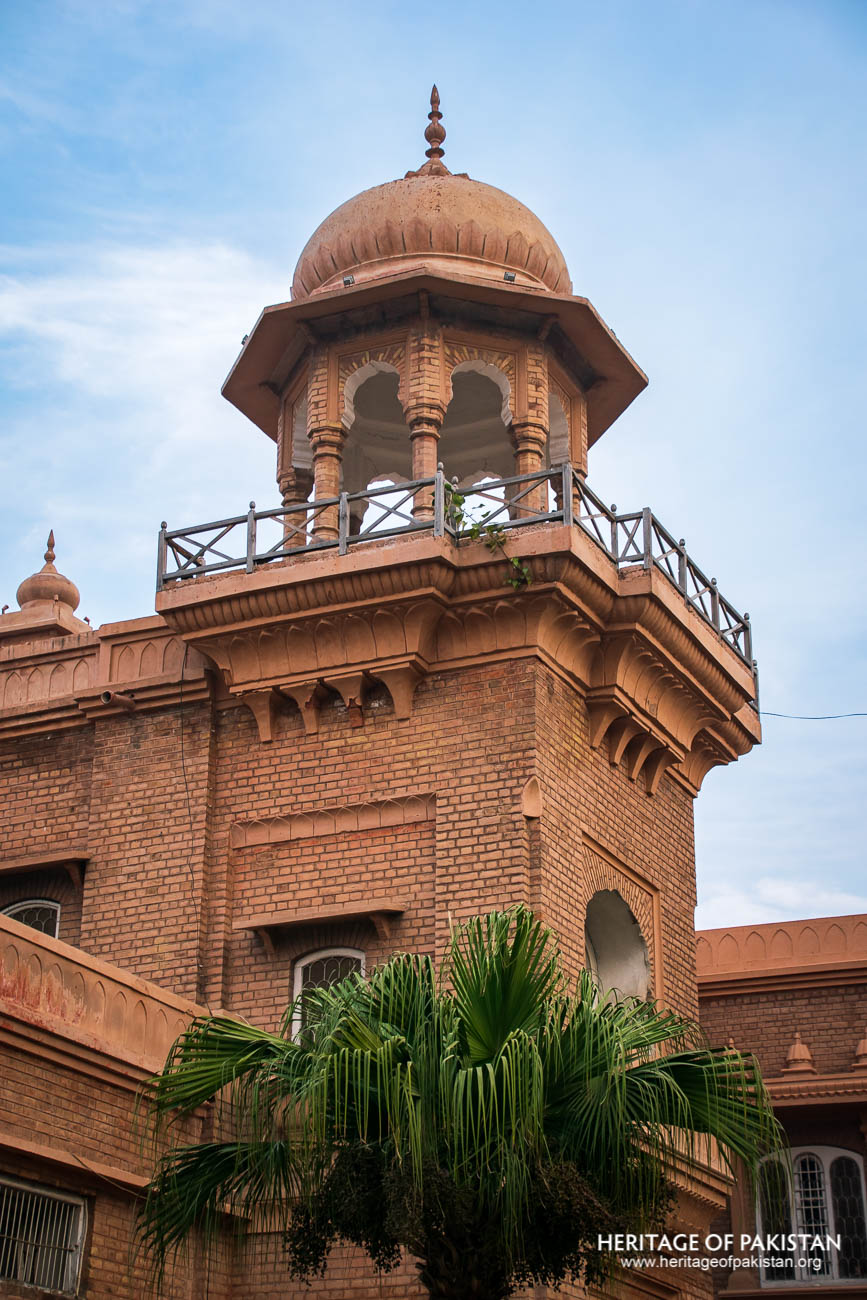

The building that houses the Peshawar Museum was originally erected in 1906–07 as the Victoria Memorial Hall, a commemorative structure designed in the Indo‑Saracenic style that merges European motifs with those of the Indo‑Subcontinent, particularly Mughal architecture. Executed in red brick, the façade is distinguished by elevated Mughal chhatris—or domed kiosks—perched on its corners, while projecting jhārokhās, cusped arches and battlement‑style parapets further reinforce the Indo‑Islamic aesthetic.
In its earliest configuration the structure rose two storeys and comprised a central main hall flanked by side aisles on both the ground and first floors. Four graceful cupolas crowned the roofline, and small pinnacles accented each corner, producing a balanced silhouette that blended British civic formality with Mughal vertical emphasis. Subsequent expansion respected this symmetry: in 1969–70 one additional hall was appended on each of the eastern and western elevations, mirroring the original fabric, and in 1974–75 a second storey was added above these new wings, retaining the vocabulary of arches, domes and red‑brick detailing.
The interior is organised around a monumental, double‑height atrium that functions as the museum’s principal display space. This atrium is ringed by galleries on both the ground and upper levels, connected by staircases that rise behind the side aisles. Clerestory windows and ventilator openings introduce ample natural light, illuminating the collection and accentuating the pointed arches that line the hall—features that underscore the Islamic influence within the broader hybrid scheme. The generous height of the central court permits the exhibition of large Gandhāran sculptures, for which the Peshawar Museum is renowned.
Overall, the Victoria Memorial Hall’s Indo‑Saracenic synthesis—expressed through red‑brick construction, Mughal‑style chhatris, projecting balconies and castellated parapets—embodies the fusion of British institutional aspirations with regional architectural traditions. Its successive adaptations in 1969–70 and 1974–75 demonstrate a continuing commitment to preserve stylistic coherence while expanding the building’s capacity for cultural display.
All Photographs by Syed Noor Hussain and Sania Azhar.
All Rights Reserved. Photos may be used for Non-Commercial, Educational, Artistic, Research, Non-Profit & Academic purposes.
Commercial uses require licensing agreement.

Syed Noor Hussain
July 23, 2025 at 4:06 amBest