
Protected Under
Antiquities Act 1975
32°57'52.9"N 73°34'23.2"E

On the UNESCO World Heritage Site List
Antiquities Act 1975
The fort spans over 70 hectares and features 68 bastions and 12 monumental gates
The Best Time to Visit Punjab Province is Year long as it has bearable Cold winters and Hot Summers. However, Summers can get really Hot and precautions are recommended during Daytime visits.



The iconic Sohail Gate, Rohtas Fort
Rohtas Fort is a monumental fortress from the Suri era, located near Jhelum in the Punjab province of Pakistan. Constructed during the reign of Sher Shah Suri, it served a critical strategic function in consolidating control over the region and securing the route from the north to the plains of Punjab. The fort was erected at a carefully selected location to block the old invasion path into the heartland of India and to check the influence of local tribes allied with the Mughals. Due to its architectural significance and historical value, Rohtas Fort has been inscribed on the UNESCO World Heritage Sites list and is protected under the Antiquities Act of 1975.
Sher Shah Suri, originally named Farid Khan, was a formidable Pathan general who rose to power after serving in the Mughal army. He eventually turned against the Mughals and captured the Indian throne by defeating Humayun, the son of Babur, at the Battle of Chaunsa in 1539. Following Humayun’s retreat to Persia, Sher Shah sought to prevent any attempt by the former emperor to reclaim power. He anticipated that Humayun, in alliance with his brother Kamran in Kabul and Mirza Haider in Kashmir, might regroup at Peshawar to stage a counteroffensive. Additionally, the Gakhars of the Salt Range, who were known allies of the Mughals, posed a local threat.
To neutralize both the external and internal challenges, Sher Shah launched a campaign against the Gakhars in the Jhelum area. After defeating them, he ordered the construction of a fortified complex to permanently secure the region. The fort was named ‘Rohtas’ after the Rohtasgarh Fort in the Shahabad district, which Sher Shah had previously captured from a Hindu Raja in 1539. The landscape around the Jhelum site resembled that of Rohtasgarh, further influencing the naming decision.
 Haveli Man Singh, Rohtas Fort

View of Shah Chandwali Gate, Rohtas Fort, Punjab
Construction of Rohtas Fort began in 1541 under the supervision of Todar Mal Khatri, Sher Shah’s revenue minister. The total expenditure on the project amounted to Rs. 34,25,000, a substantial sum for the period. A marble slab at the Shishi Gate bears an inscription commemorating its foundation in the year 948 Hijri (1541 AD). The inscription reads: “In the Hijri year 948 came the exalted. At that time constructed the great fort. The emperor is Sher (Shah), with long life.
There is no match to his good fortune. It was completed by Shahu Sultan.”
Despite its grand conception, Sher Shah Suri died before the fort’s completion. When Humayun returned to the subcontinent via Kabul, the then governor of Rohtas, Tatar Khan Kasi, offered no resistance and fled, allowing the Gakhars to once again ally themselves with the Mughals. Although the fort served its immediate purpose during the Suri era, it did not hold lasting significance for the subsequent Mughal rulers. Emperor Akbar stayed at the fort for just one night, and Emperor Jahangir, on his way to Kashmir, visited it a few times.
In later periods, the fort was used intermittently. The Durrani invaders stationed a garrison there and appointed a governor. However, under Sikh rule, Maharaja Ranjit Singh did not utilize the fort and instead bestowed it upon Mohar Singh.
Rohtas Fort is renowned for its vast scale and robust military architecture. It contains 68 bastions and 12 monumental gates. These include the Sohail Gate, Shah Chandwali Gate, Kabuli Gate, Shishi Gate, Langar Khani Gate, Talaqi Gate, Mori Gate, Khwas Gate, Tulla Mori Gate, Gatali Gate, Pipalwala Gate, and Sar Gate. The fort remains accessible today via a connecting road from Dina, located along the historic Lahore-Rawalpindi Grand Trunk Road.


Details of Sohail Gate, Rohtas Fort
Rohtas Fort is a significant historical and architectural landmark, constructed with strategic foresight in the northern Punjab region of present-day Pakistan. It is located within the rugged terrain of the Tilla Range, precisely at a gorge where the River Kahan takes an eastward turn. The placement of the fort reflects its primary function as a military stronghold, enabling control over key routes and natural features. The fort covers an area of approximately 70 hectares and has a perimeter measuring about 4 kilometres. Its layout is irregular in shape, shaped by the natural contours of the surrounding terrain, which was skilfully integrated into the planning of the structure.
The fortification wall is among the most prominent features of Rohtas Fort, designed for robust defence. Its height ranges from 10 to 18 metres, and its thickness varies, reaching up to 12.5 metres at certain points. The wall includes 68 bastions constructed at regular intervals, serving both defensive and surveillance purposes. Internally, the wall is structured with two or three terraces, connected by staircases to facilitate patrolling and movement along its length. The uppermost terrace is aligned with battlements that incorporate merlons, crenels, and machicolations. These elements were essential in the fort’s defensive strategy, enabling musket fire and allowing defenders to pour hot oil or water on attackers. The construction technique involves sandstone coarse rubble masonry, using stones of varied shapes and sizes. In contrast, the gates are built in ashlar masonry, employing finely cut and dressed stone. Lime mortar mixed with granular brick was used as the binding agent in the construction.

Rani Mahal (Queen's Palace) Rohtas Fort, Punjab

Merlons on Sohail Gate, Rohtas Fort

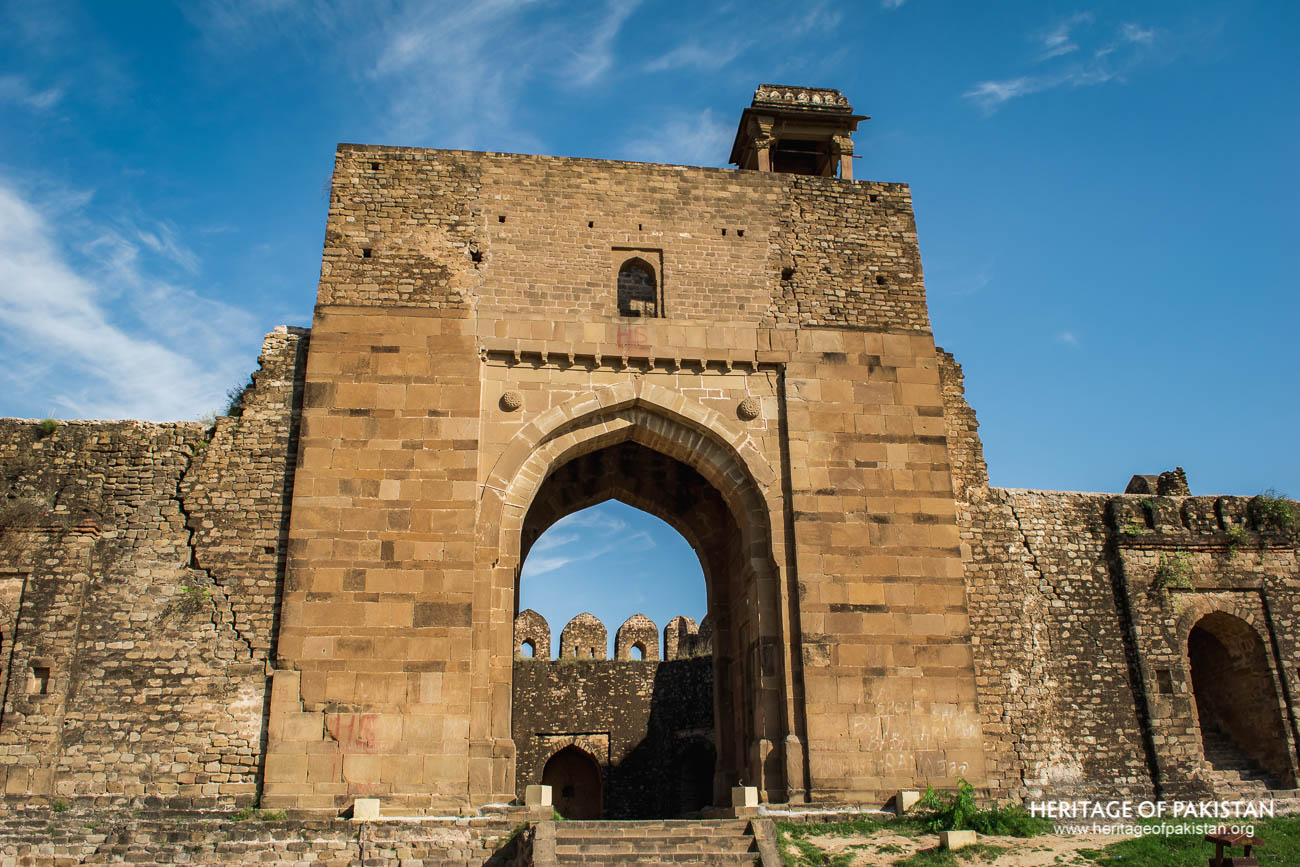
The Sohail Gate has two Massive Bastions, Rohtas Fort, Punjab
The fort includes twelve access gates, each with distinct architectural features and historical associations. The most prominent is the Sohail Gate, named after the saint Sohail Bukhari, whose tomb is located in one of the bastions. This gate is characterized by its two massive circular bastions and a central arched entrance framed within a Pishtaq, a hallmark of Timurid-style iwans. Decorative features include seven merlons at the top, each with twin slits, and half-merlons at the sides. Two intricately carved jharokas flank the arch on both sides, while the spandrel of the arch bears a sun motif relief.
The Shah Chandwali Gate connects the main fort with the citadel. It is named after a saint who is said to have participated in the construction of the gate without accepting wages. His tomb is located adjacent to the gate. The Kabuli Gate, facing toward Kabul, is more modest in form compared to the Sohail Gate. It is a rectangular structure with two bastions and an arched entrance. Located near it is the Shahi Mosque, also known as the Royal Mosque.
Shishi Gate derives its name from the Kashi Kari, or glazed tilework, on the spandrels of its outer arch. The reflective quality of the blue tiles earned it the name "Shishi Darwaza," or Glass Gate. Langar Khani Gate is a large entrance leading to the Langar Khana, the communal mess area. Talaqi Gate, sometimes referred to as the "Condemned Gate," is associated with the illness of Sabir Suri upon entering, which led to its reputation as being unlucky. Kashmir Gate, also called Mori Gate, opens to the northern direction towards Kashmir. Khwas Khani Gate is named in honour of Sher Shah Suri’s loyal commander. The main road from Dina to Rohtas passes through this gate. Other gates of the fort include the Gatali Gate, Tulla Mori Gate, Pipal Wala Gate, and the Sar Gate, also known as the Water Gate.

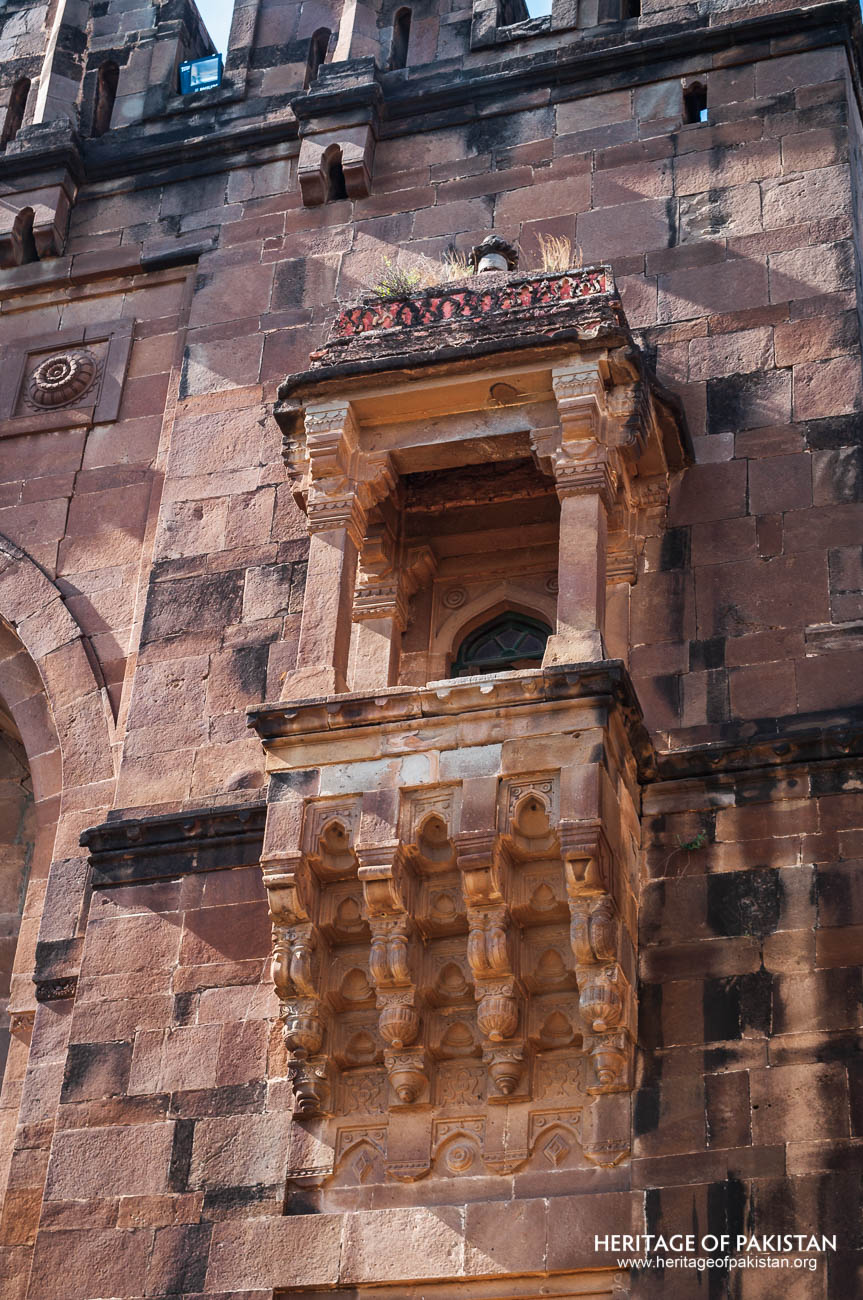
Jharoka and Carved brackets of Sohail Gate, Rohtas Fort
Water supply within the fort was ensured through the construction of three baolis, or stepped wells. These wells required extensive excavation into natural limestone to reach the groundwater level and served as a crucial element of the fort’s infrastructure.
Religious and residential structures within the fort reflect its broader functional and cultural dimensions. The Badshahi Mosque, situated near the Kabuli Gate within the citadel, is a modest structure composed of a single chamber and a courtyard. The mosque’s façade is marked by three arched openings leading into the prayer hall. Notably, it lacks domes, differing from the more elaborate mosque designs seen in later Mughal architecture.
Among the residential structures is the Haveli Man Singh, attributed to Raja Man Singh, a general under Emperor Akbar. Built between 1578 and 1585 during his service in Punjab, the haveli originally comprised four rooms, though only one remains today due to partial collapse. Another significant structure is the Rani Mahal, or Queen’s Palace, built around the same period. This structure also survives in part, featuring a square base surmounted by a fluted dome.
In the vicinity of Rohtas Fort lies the Gurdwara Chowa Sahib, adding another layer of religious and historical significance to the area. The fort, in its conception and execution, successfully fused architectural traditions from Turkey and the Indian subcontinent. This blend laid the foundation for what would later evolve into the distinctive style of Mughal architecture, making Rohtas Fort both a military and cultural prototype in the architectural history of the region.

All Photographs by Syed Noor Hussain and Sania Azhar.
All Rights Reserved. Photos may be used for Non-Commercial, Educational, Artistic, Research, Non-Profit & Academic purposes.
Commercial uses require licensing agreement.

Syed Noor Hussain
July 23, 2025 at 4:04 amBest