
Protected Under
Antiquities Act 1975
33°44'40.5"N 72°50'32.2"E

On the UNESCO World Heritage Site List
Antiquities Act 1975
The Dharmarajika Stupa is believed to be one of the original eight stupas built by Emperor Ashoka to house the relics of the Buddha
The Best Time to Visit Punjab Province is Year long as it has bearable Cold winters and Hot Summers. However, Summers can get really Hot and precautions are recommended during Daytime visits.

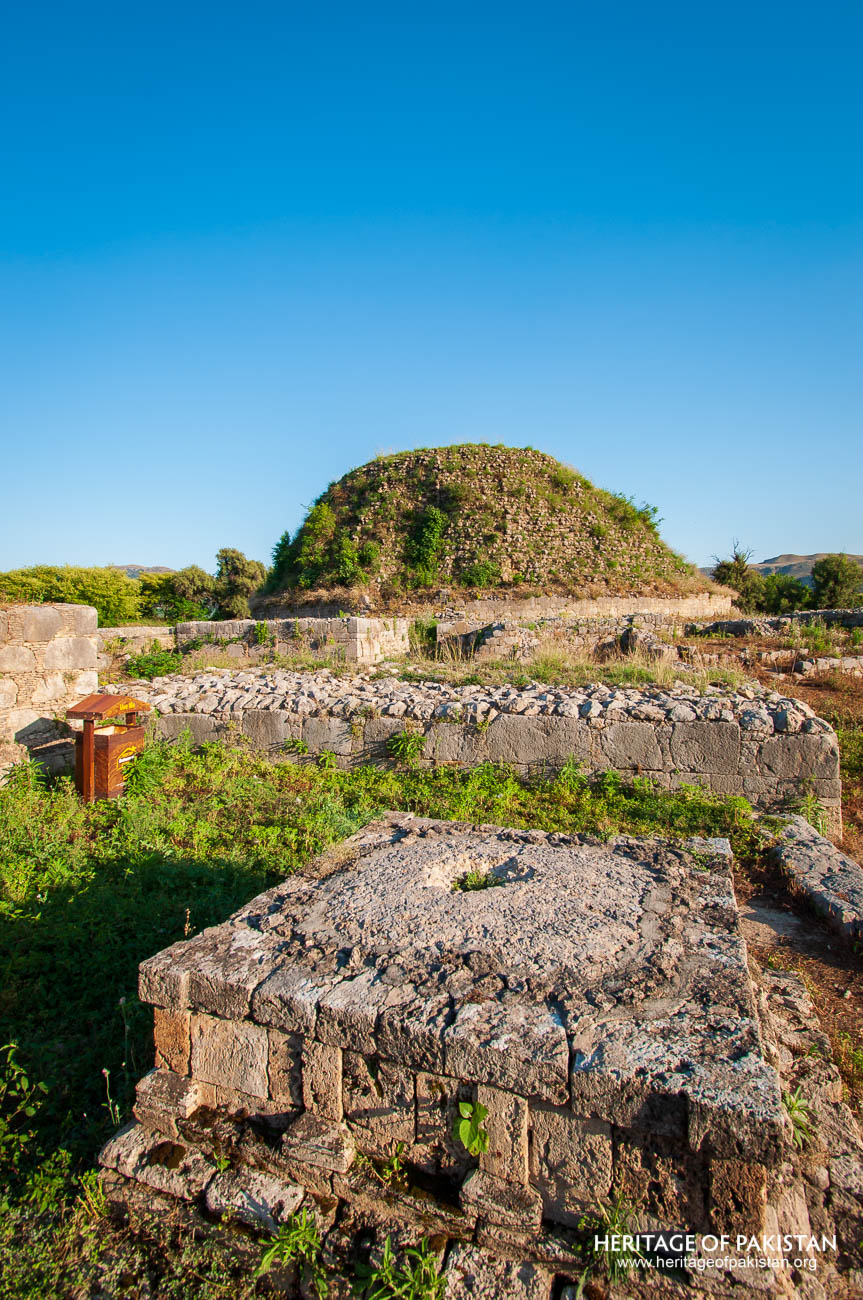
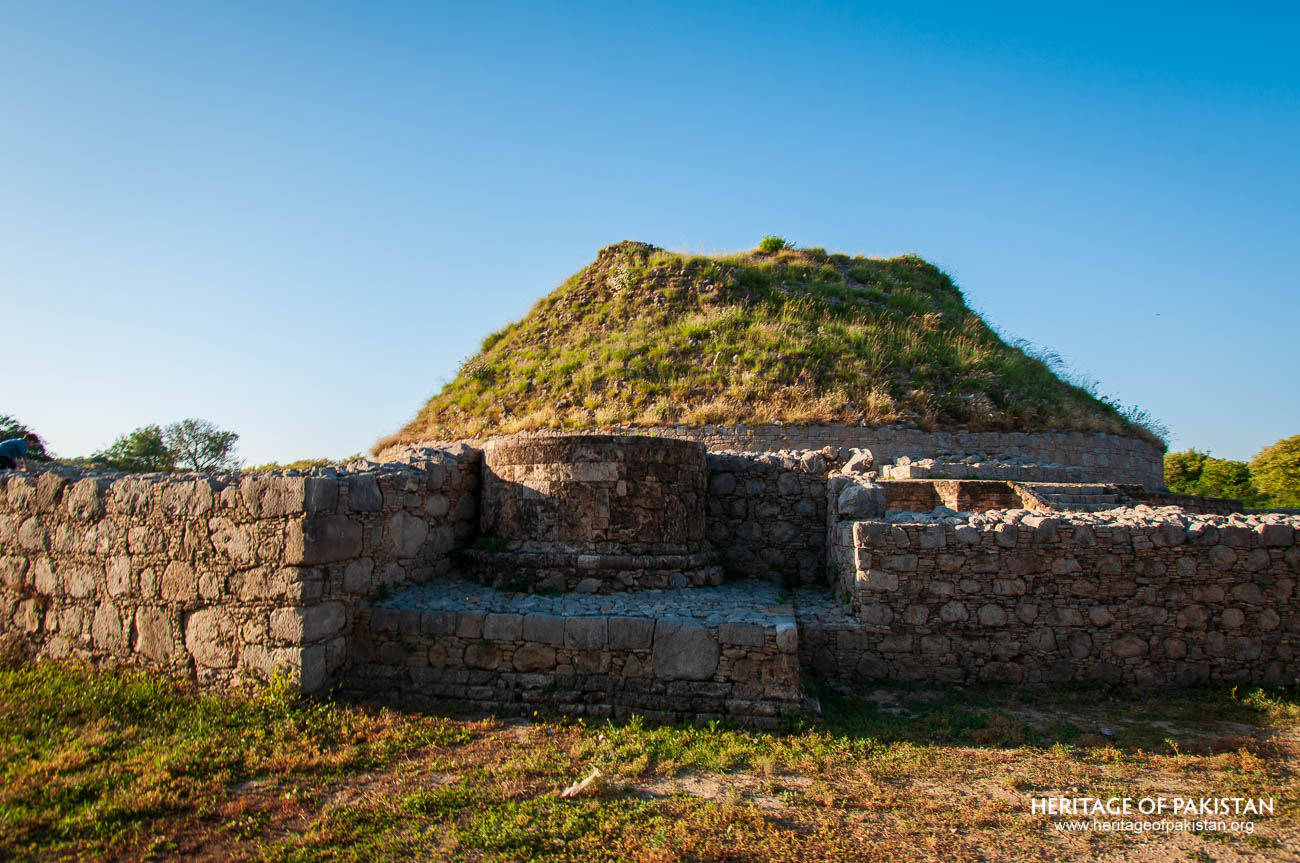
3rd Century BC Dharmarajika Stupa at Taxila, Punjab
The Dharmarajika Stupa, located in Taxila, is among the earliest and most significant Buddhist monuments discovered in Pakistan. It represents one of the earliest efforts to institutionalize Buddhist worship in the region and remains a key archaeological site. Taxila itself was inscribed as a UNESCO World Heritage Site in 1980 due to its rich cultural and historical value. The stupa functions both as a religious structure and a Buddhist monastery, serving spiritual and communal roles in ancient Buddhist society.
The Dharmarajika Stupa is believed to be one of the eight original stupas constructed by Emperor Ashoka of the Mauryan Dynasty in the 3rd century BC. As Ashoka is also referred to as the ‘Dharma Raja’ or Righteous King, the stupa was named in reference to him, and by extension, to the Buddha himself, who is regarded in Buddhist tradition as the true Dharma Raja, or Law Lord. Built to enshrine the relics of the Buddha, the structure served as a model for later Buddhist architectural undertakings. Prior to its construction, the site was inhabited as a village, evidenced by the discovery of twenty-eight coins belonging to the Greek King Zoilus found beneath the foundation of one of the structures.
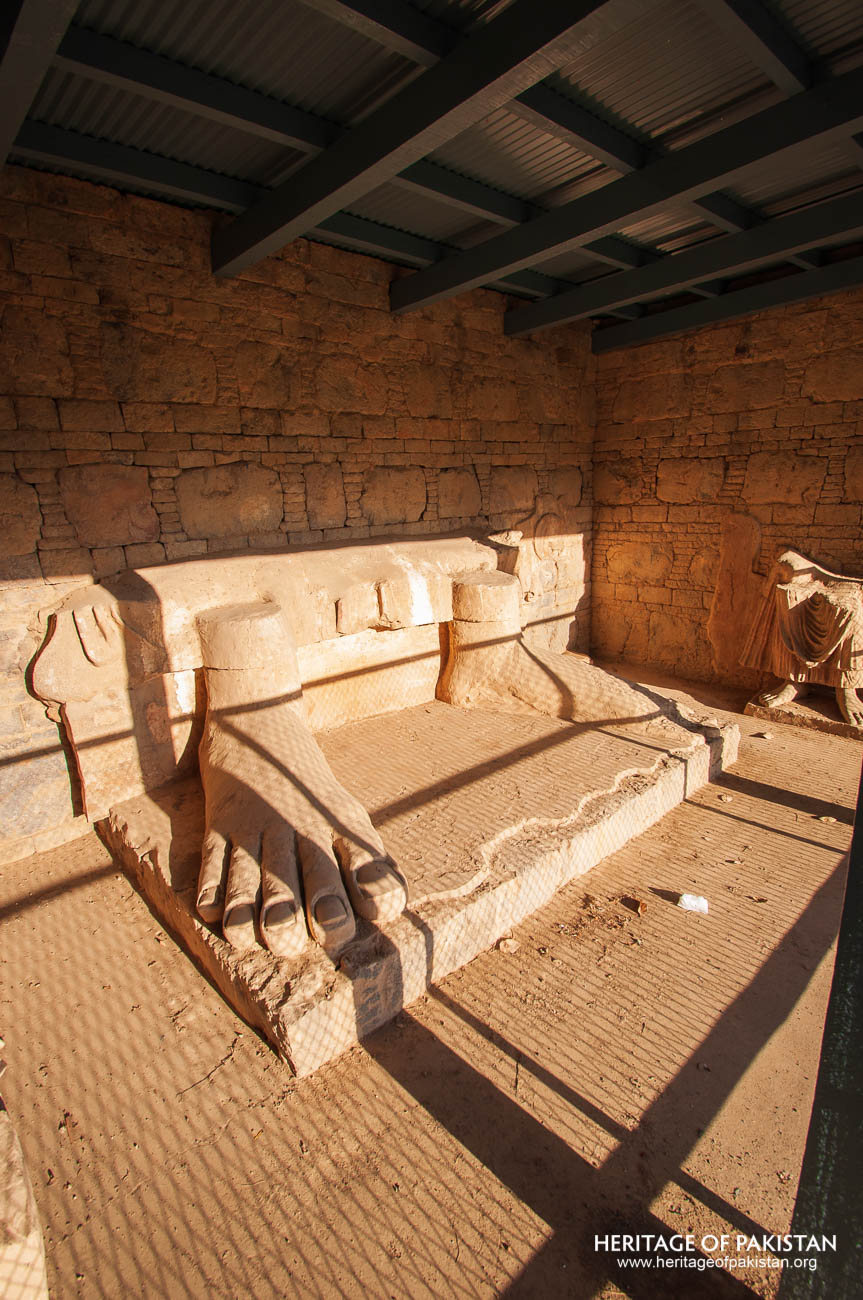 Remains of a large sculpture at Dharmarajika Stupa, Taxila
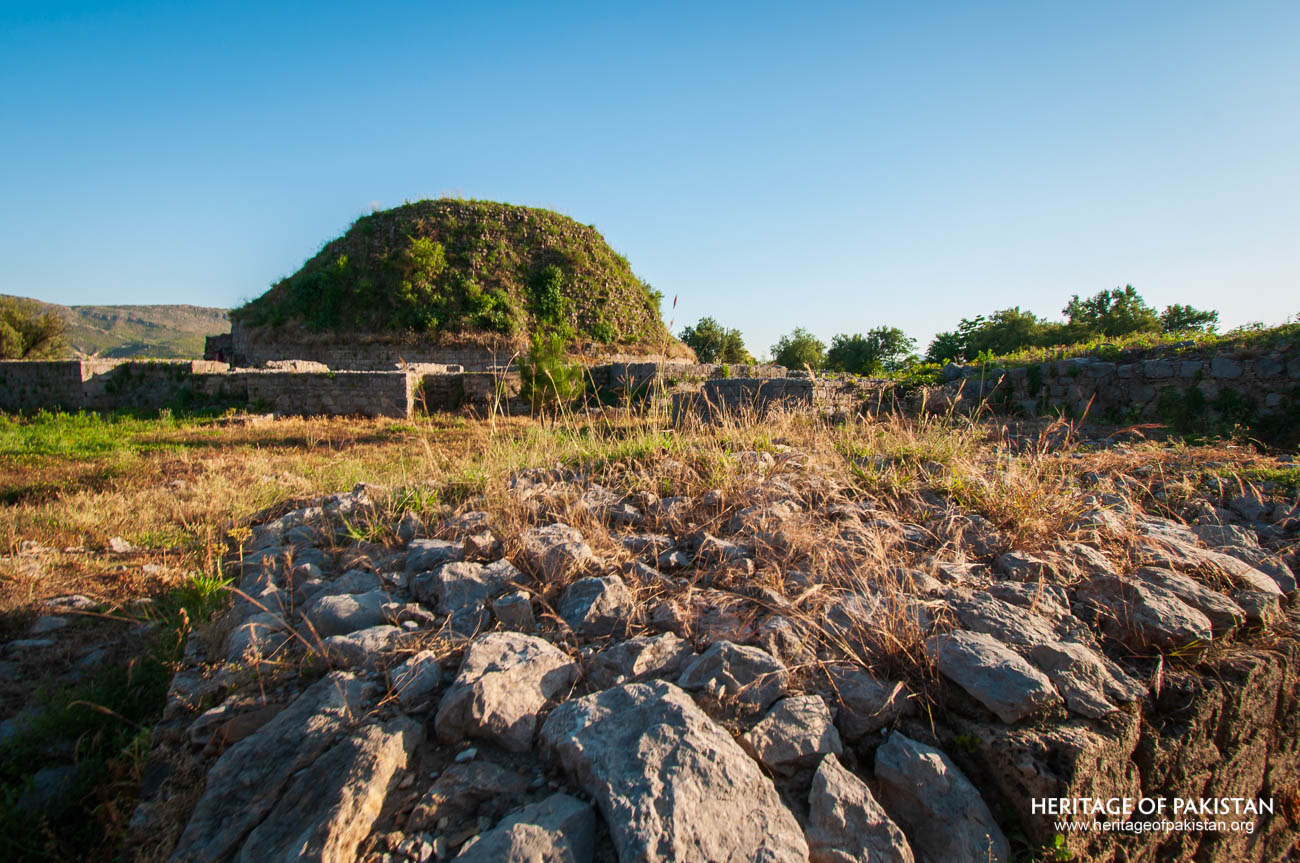
View of Dharmarajika Stupa at Taxila
The stupa is positioned prominently on a plateau above the Tamra Nala and is locally known as ‘Chir Tope’ or Split Mound. This name derives from the large cleft visible in its center, which was caused by early explorers or treasure hunters searching for hidden relics. The earliest round of systematic excavations at Dharmarajika was carried out between 1912 and 1916 by Mr. Ghulam Qadir under the direction of Sir John Marshall, and later from 1934 to 1936 by Mr. A.D. Siddiqui.
Over the centuries, the Dharmarajika complex underwent several phases of expansion, reaching its architectural height in the 2nd century AD. An earthquake between 25 and 30 AD caused substantial damage to the stupa and other nearby structures in Taxila. These were later repaired, showing signs of architectural evolution over time. The attached monastery, located north of the main stupa, includes constructions dating from the 1st to the 6th century AD. The presence of six skeletons discovered at the site has been interpreted as evidence of a massacre, which is generally linked to the White Hun invasion at the end of the 5th century AD.
A notable inscription found at the site, written in the Kharoṣṭhī script and dated to the year 136 of Azes (78 AD), confirms that the relics housed within the stupa belonged to the Buddha himself. The inscription reads: “In the year 136 of Azes, on the 15th day of the month of Ashadha, on this day relics of the Holy One (Buddha) were enshrined by Urasakes, son of Lotaphria, a man of Balkh, resident at the town of Noacha..” It also refers to the place as Takshasila (Taxila) and identifies the donor as a Bactrian.
Excavations have yielded a wide range of artifacts, including coins, beads, jewelry, and earthenware lamps. Among the most significant discoveries were relics such as Scythian coins, a steatite vase, beads made of precious stones, and a miniature gold casket. In February 1917, these relics were presented by Viceroy Lord Chelmsford to the Buddhists of Ceylon (now Sri Lanka), who enshrined them in the Temple of the Tooth Relic (Dalada Maligawa) in Kandy.
The Dharmarajika Stupa stands today not only as an architectural remnant but as a vital testament to the religious, cultural, and historical currents that shaped the region from the Mauryan period onward.

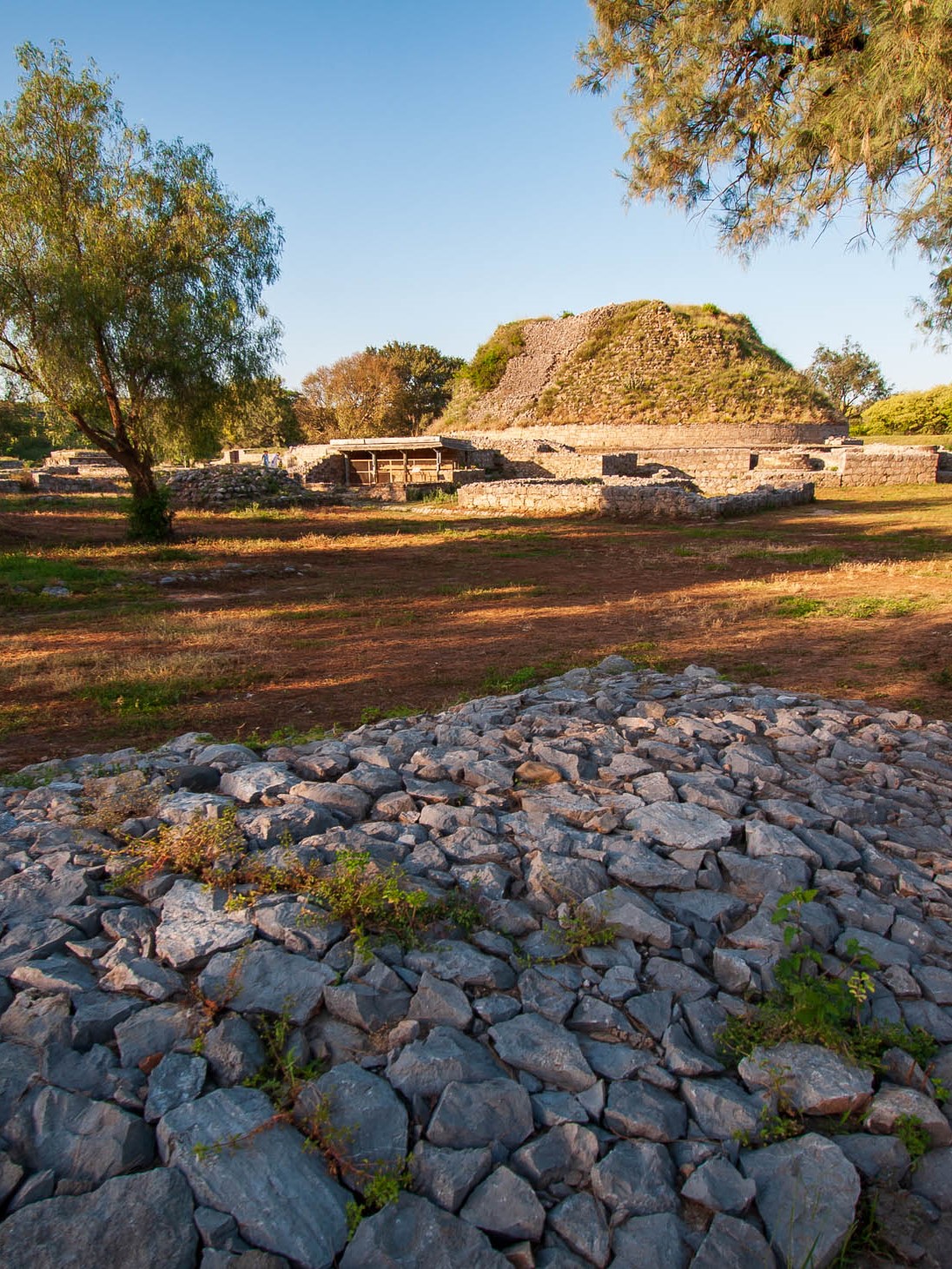
View of Dharmarajika Stupa, Taxila
A Buddhist stupa is a symbolic architectural structure that enshrines the relics of the deceased, typically a revered figure such as the Buddha or a Buddhist saint. The relics are placed within a casket, turning the stupa into a sacred object of worship. Stupas came to serve both as reliquaries and as devotional monuments, integral to Buddhist ritual life. Over time, these structures evolved into prominent architectural features, often forming the nucleus of Buddhist monasteries. There are four general types of stupas: relic stupas (containing bodily remains of the Buddha or disciples), commemorative stupas (marking significant events in the Buddha’s life), votive stupas (built as devotional offerings), and model stupas (serving as representations or didactic tools). These structures gradually developed into large hemispherical domes, with a characteristic design including a square or circular base, a cylindrical drum, a large dome, and a harmika – a square railing containing the relics, topped by an upright staff bearing seven umbrella-like discs.
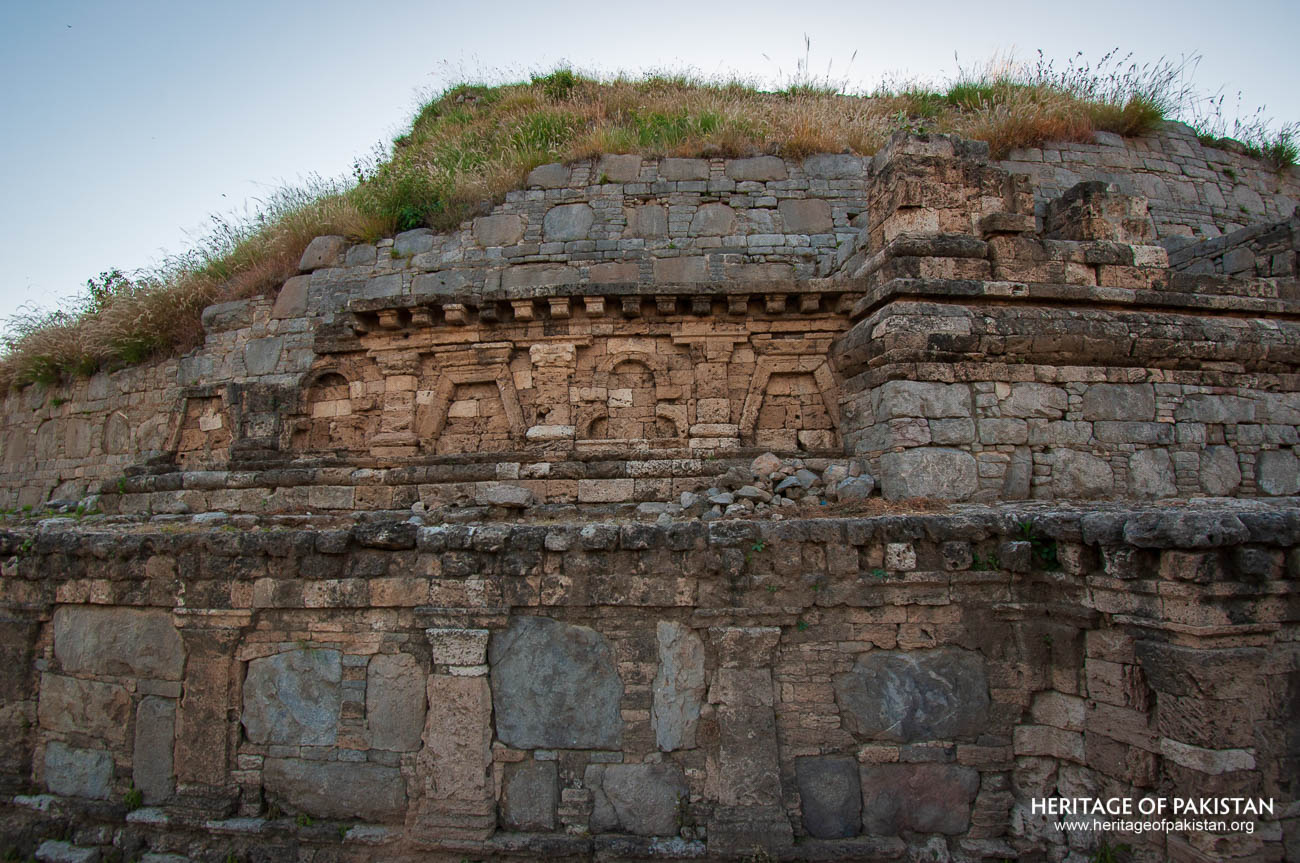
Stone columns and decorative niches on the Dharmarajika Stupa
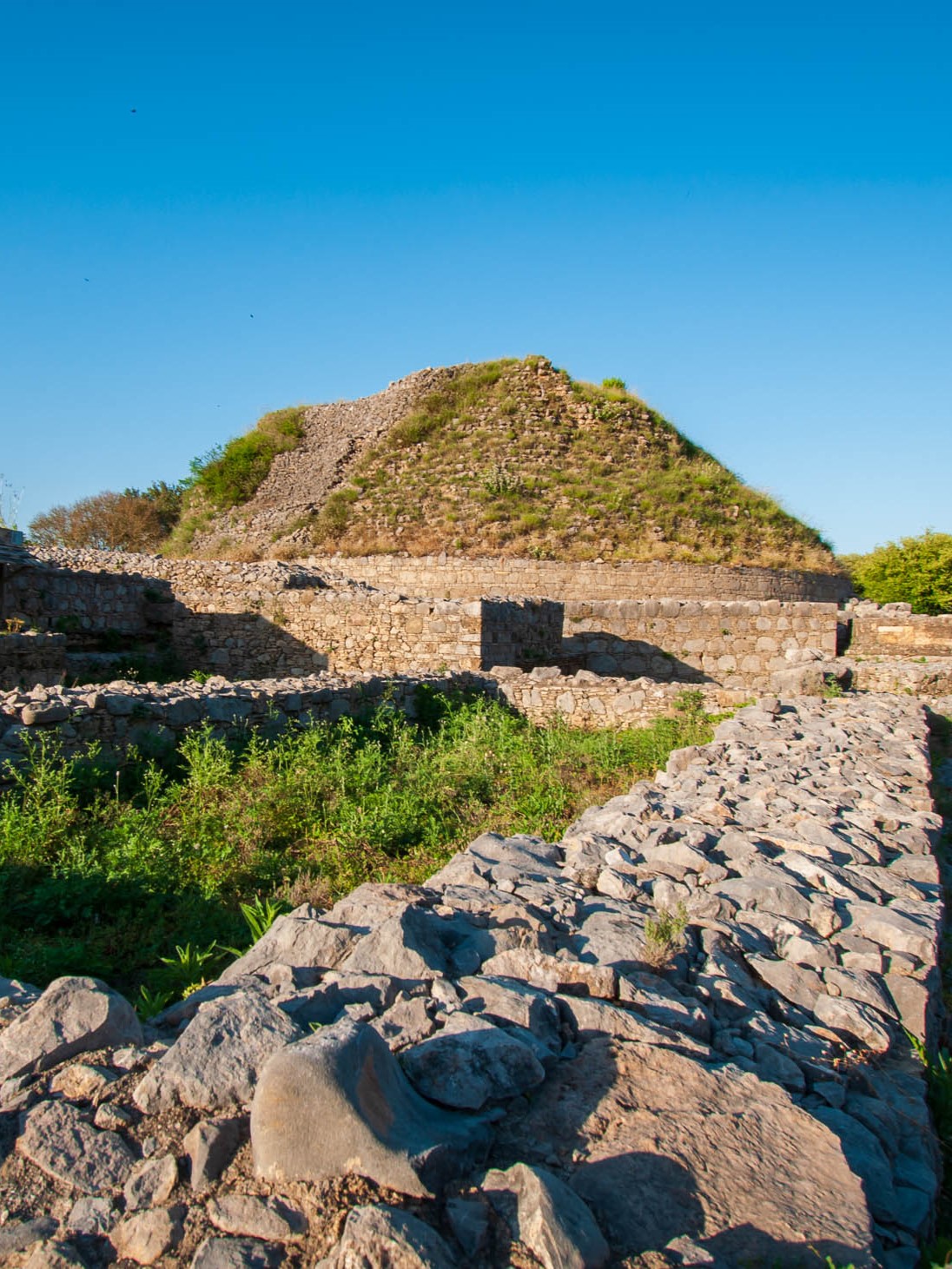
Masonry of Dharmarajika Stupa
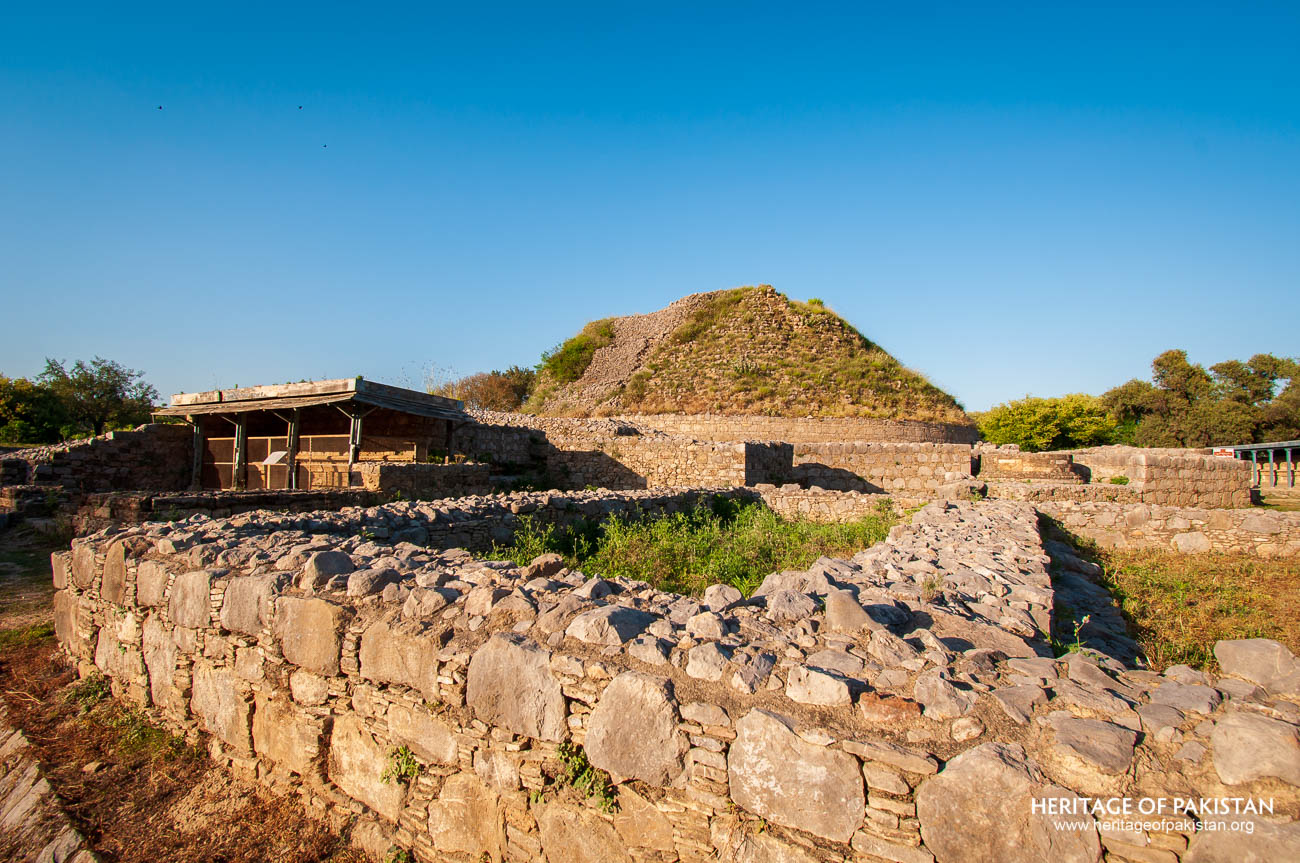
Diaper Masonry of Dharmarajika Stupa, Taxila
The stupa at Dharmarajika in Taxila represents the largest stupa uncovered at the site and exemplifies the round drum type. Although it does not survive in its original form, the remnants convey the scale and intricacy of its design. The main stupa is circular in plan and stands on a raised platform that is ascended by four stairways positioned at the cardinal points – north, south, east, and west. The platform, known as the plinth, is stepped and supports the cylindrical drum of the stupa. This base was constructed to facilitate the ritual of circumambulation, a devotional practice known as *pradakshina* or *parikarma*, wherein monks and devotees walk clockwise around the stupa, always keeping it to their right. This act, performed in multiples of three, seven, fourteen, or even 108 rounds, is considered spiritually purifying and is believed to cleanse one’s karma. The original circumambulatory path around the stupa was constructed using lime mixed with river sand, and later covered in glass tiles, remnants of which have been discovered.
The entire stupa complex measures approximately 150 feet in diameter, including terraces and steps, while the pathway for circumambulation around the drum is about 8 feet wide. The extant height of the main stupa is about 45 feet. The stupa is constructed of rough rubble masonry with radiating walls—3 to 5 feet thick—extending outward from the center to support and strengthen the structure. The outer face is built from limestone blocks combined with a local stone known as *kanjur*. The entire exterior was once finished with lime plaster and painted.
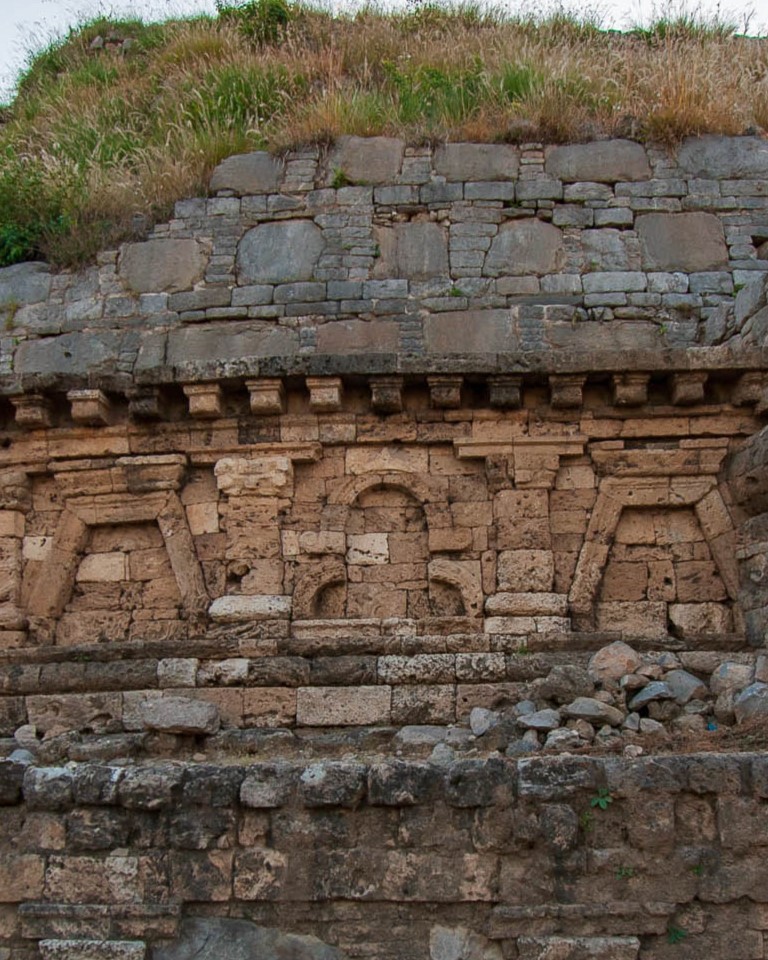
Decorative Niches on the Dharmarajika Stupa
Ornamental details survive primarily on the eastern side of the stupa. Here, two distinct types of decorative niches can be observed. One features the trefoil arch, a design formed by the intersection of three circles; the other resembles a tapering trapezoidal doorway. These niches are arranged alternately and separated by Corinthian pilasters—engaged columns of the Corinthian order. The niches once housed reliefs of the Buddha or Bodhisattvas. A prominent dentil cornice, a series of rectangular tooth-like blocks, runs along the upper edge of this decorative register. Sir John Marshall attributed these decorative elements to the Kushan period, although the original structure of the stupa was likely built during the Scytho-Parthian era and later expanded and embellished under Kushan patronage. Similar decorative features are found on smaller stupas within the same complex, constructed between the 3rd and 5th centuries AD.
On the eastern side, adjacent to the stairway, remnants of a pillar have been found, with only the lower section still intact. This may have originally supported a lion capital akin to those erected by Emperor Ashoka. Notably, a similar lion capital has been adopted as the national emblem of India. The masonry throughout the Dharmarajika complex belongs to various periods, with multiple construction techniques observed, including rubble masonry, small diaper, large diaper, and semi-ashlar styles, reflecting the chronological evolution of the site’s development.
Surrounding the main stupa are numerous smaller votive stupas arranged in a circular pattern. These votive stupas were typically built as devotional offerings or to commemorate particular events. Coins attributed to the Saka kings Maues and Azes I were found within the relic chambers of some of these votive stupas, suggesting their origin in the latter half of the 1st century BC. To the eastern side of the main stupa are the remains of another stupa constructed on a square plinth. Around the main structure, several chapels and monastic quarters have also been identified. In one of the chapels, fragments of a colossal Buddha statue have been excavated; notably, only the feet—each five feet in length—survive, implying that the original statue may have been approximately 35 feet tall, and the chapel itself would have required a minimum height of 40 feet to accommodate it.
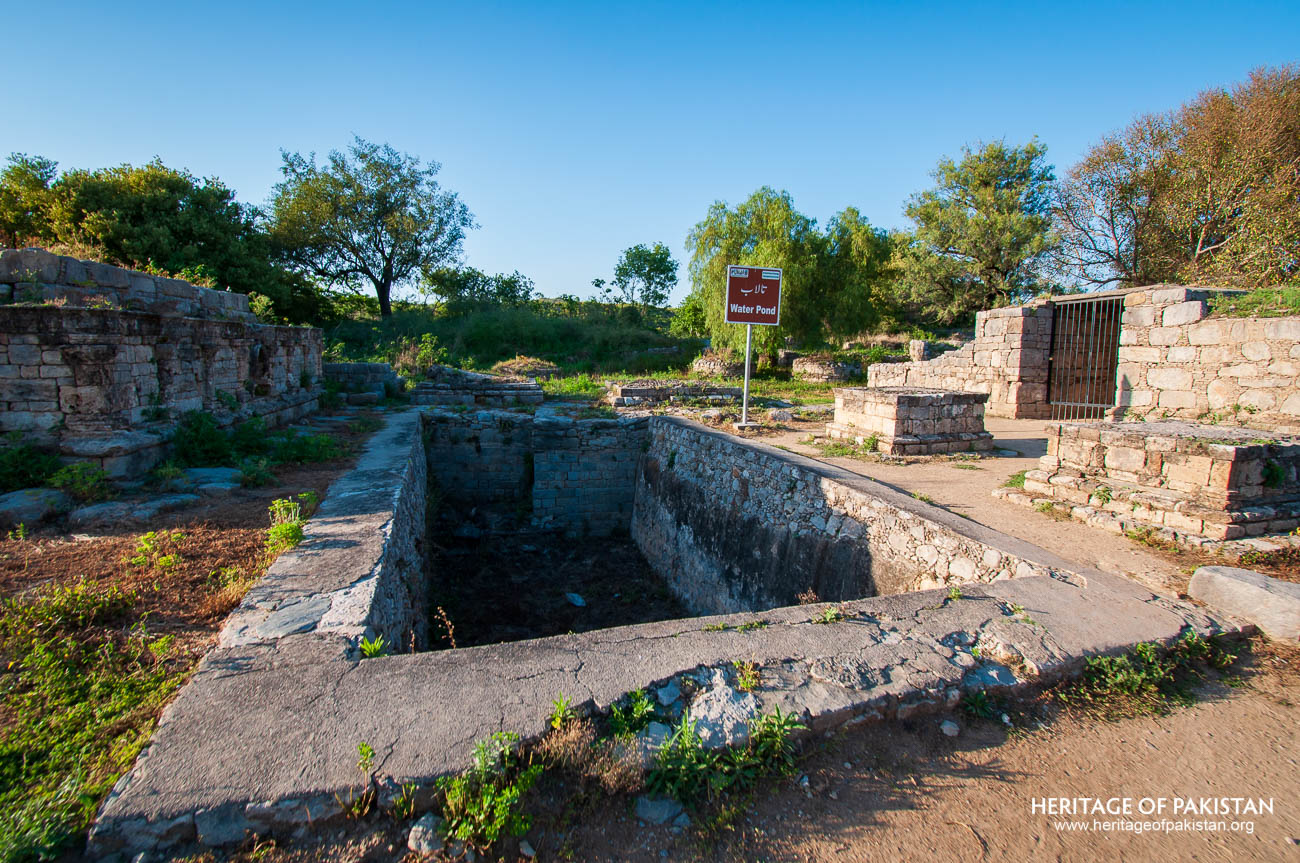
Additionally, a large water tank with steps leading to its bottom has been discovered within the complex, likely used for ritual or practical purposes. The Dharmarajika stupa, with its architectural, ritual, and artistic elements, serves as an important example of early Buddhist monumental architecture in the region and provides significant insight into the development of Buddhist religious practices and architectural forms in ancient Gandhara.
All Photographs by Syed Noor Hussain and Sania Azhar.
All Rights Reserved. Photos may be used for Non-Commercial, Educational, Artistic, Research, Non-Profit & Academic purposes.
Commercial uses require licensing agreement.

Syed Noor Hussain
July 23, 2025 at 4:04 amBest